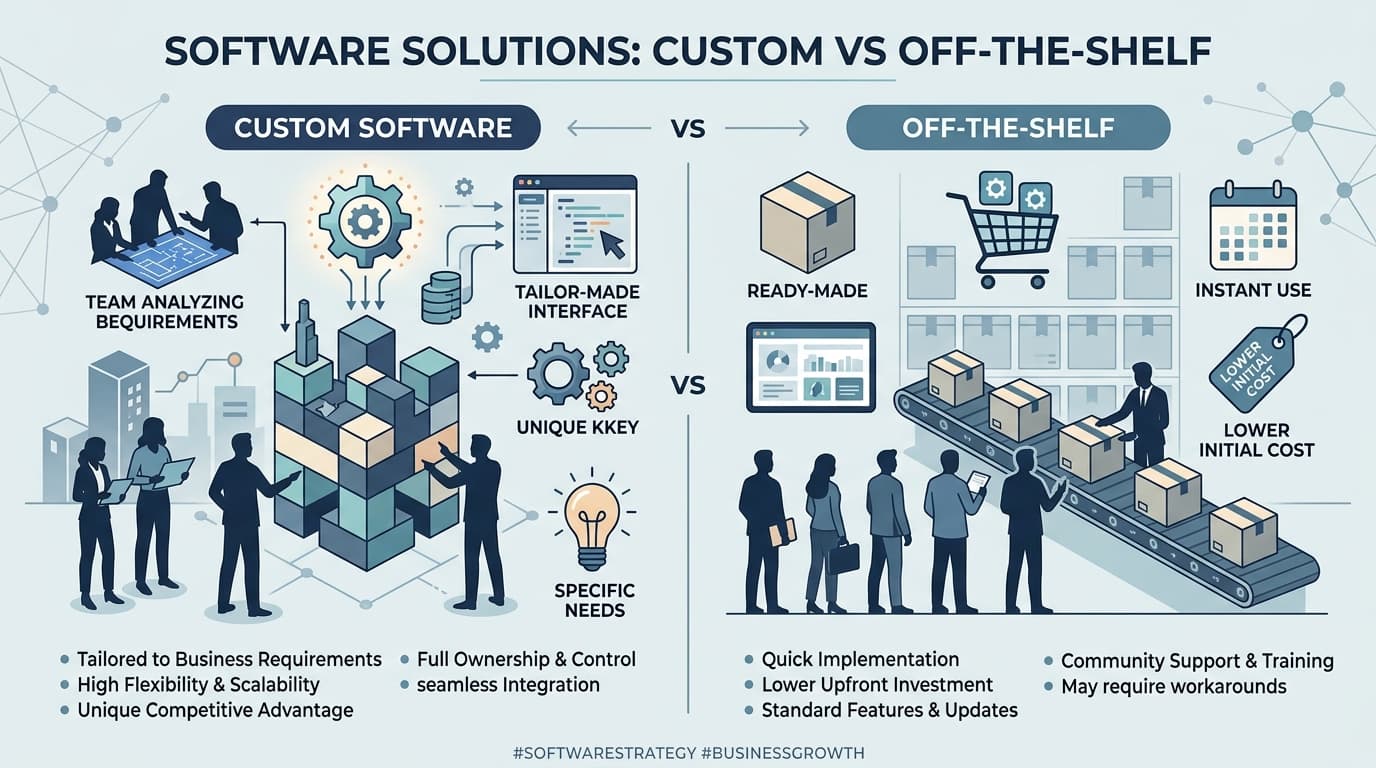
How to Choose the Right Tech Stack for Your Product in 2026
Tech stack selection in 2026 is a strategic business decision, not just a technical one. Discover the key factors, frameworks, and pitfalls. Get expert
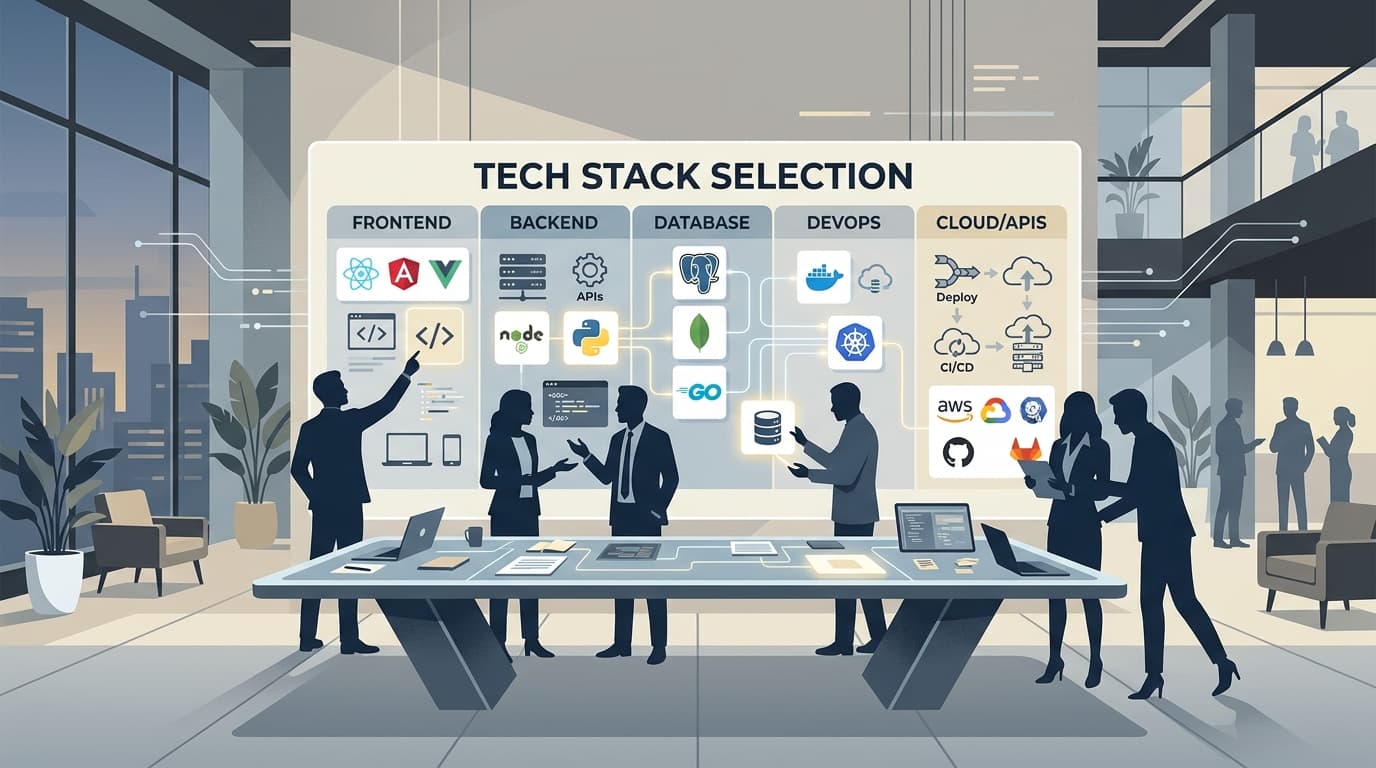
The decision that shapes everything else Pick the wrong tech stack and you feel it for years. Slow builds, a hiring pool that dries up, a rewrite you never budgeted for. Tech stack selection is the single architectural decision that quietly determines your product's speed, cost ceiling, and how easily good engineers want to work on it. Get it right, and most of those headaches simply never show up. The good news? You don't need to be a CTO to think clearly about this. You need a framework, some honest data, and the discipline to match technology to your actual product goals rather than to whatever is trending on Hacker News this week. Below you'll find a practical, step-by-step approach to technology stack selection in 2026, covering the factors that matter, the traps to avoid, and a clear decision process you can use today. Start with the product, not the framework Most founders get stuck comparing frameworks when the real question is simpler: What exactly are you trying to build? A successful tech stack isn't defined by what's popular or new, but by how well it supports your product vision, user expectations, and long-term business objectives. Before shortlisting any tool, answer these questions honestly: Is the core problem your product solves clearly defined? What does your product need to do on day one versus month twelve? How many users do you expect at launch, and what does 10x growth look like? Does speed-to-market or long-term scalability take priority right now? What's the realistic budget for infrastructure and ongoing maintenance? If your goal is to launch fast and test the market, a lightweight stack lets you move quickly. But if you already see your product scaling to millions of users or handling complex data, an enterprise-ready foundation can save you a painful and expensive rebuild within two to three years. Vision matters far more than technical buzzwords. Set it first, and every other decision follows naturally. The five factors that actually drive good tech stack selection Once you know what you're building, evaluate your options against these five dimensions. None of them work in isolation, and cutting corners on any one of them tends to create compounding problems later. 1. Scalability Can your chosen stack handle 10x your current traffic without a major rewrite? Think about both horizontal scaling (adding more servers) and vertical scaling (bigger servers with hardware limits). Your database choice matters just as much here. SQL databases keep information in structured tables and excel at relational data; NoSQL options offer more flexibility in format but require careful schema planning. What works for 100 users can break under 100,000 if you haven't thought this through up front. 2. Team capability and talent availability Your team's existing skills matter more than the "objectively best" technology. Even the most innovative stack will underdeliver if the people building on it don't know it well. Choosing a niche or bleeding-edge framework creates a second problem: finding qualified developers becomes genuinely difficult and expensive. The data backs this up. According to the 2025 Stack Overflow Developer Survey, which polled over 49,000 developers across 177 countries, JavaScript remains the most widely used language at 66%, while Python surged 7 percentage points year-over-year, largely driven by AI and backend demand. PostgreSQL holds the top database spot at 58.2%, and React and Node.js lead web frameworks at 46.9% and 49.1% respectively. These numbers matter because talent availability tracks adoption. A popular stack means a larger hiring pool, faster onboarding, and more third-party support when you get stuck. 3. Performance requirements Not every product needs the same performance profile. A real-time trading platform has fundamentally different latency requirements than a content-heavy marketing site. Be specific about what "performance" means for your product: requests per second, time to first byte, concurrent users, data throughput. Then match the stack to those numbers, not to a generic idea of "fast". 4. Security and compliance Security or privacy concerns are the top deal-breaker for developers evaluating a technology, according to the same Stack Overflow survey. This is worth taking seriously at the stack level, not just the application level. Choose technologies with strong security track records, active patch cycles, and well-documented best practices. If your product handles sensitive data or operates in a regulated industry, your stack choices may also need to satisfy specific compliance requirements from the start. 5. Long-term maintainability and cost The most advanced stack isn't always the most economical one. Balance performance with long-term affordability by carefully comparing hosting, licensing, and infrastructure costs. Serverless and managed services can dramatically reduce DevOps overhead for early-stage products. Aim for technologies that are stable, well-documented, and backed by large communities so that when something breaks at 2am, someone on the internet has already solved it. The 2026 landscape: what's actually changed Three structural shifts in the technology landscape are actively changing how teams approach technology selection right now. Ignore them and your stack risks feeling dated before your product hits its first birthday. AI is now a stack-level consideration In 2026, you're no longer choosing a stack just for your app logic. You're choosing whether and how AI fits into your product's core functionality. 84% of developers are using or planning to use AI tools in their development process , and that number is up from 76% just a year ago. More importantly, AI-native architectures, things like LLM orchestration layers, vector databases, and retrieval-augmented generation pipelines, are increasingly common inside products, not just inside development workflows. If your product is intelligence-driven (an assistant, a recommendation engine, semantic search), Python paired with frameworks like FastAPI and a vector database has become the default reference architecture for production systems. FastAPI's usage jumped significantly in 2025 and continues to climb, making it the framework story of the year for backend API work. Composability beats monoliths The era of debates over monoliths versus microservices has quietly given way to a new question: are you building a classic application or an AI-native ecosystem? The answer shapes your architecture. The practical rule for 2026 is that your stack must be composable , meaning modular components connected through clean APIs that can be swapped out without rewriting your entire codebase. Today you use one LLM provider; next year you may need a different one for cost or privacy reasons. A composable stack means your business logic doesn't notice the difference. Industry data shows 80% of enterprises are actively moving toward composable stacks to increase agility. That's not a trend for large organizations only; even early-stage products benefit from avoiding tight coupling between layers. The "boring stack" advantage is real There's a temptation to reach for whatever is newest. Resist it. A combination like React, Node.js, PostgreSQL, and Redis is, frankly, boring. That's precisely why it works for the vast majority of products. Proven technologies have larger talent pools, better documentation, more community-answered edge cases, and a longer runway before they go out of support. Choose boring, proven technology unless you have a genuinely compelling reason to do otherwise. The compelling reason should come from a product requirement, never from engineering preference alone. A practical decision framework you can use today Here's a four-step process for reaching a defensible, well-reasoned stack decision without months of analysis paralysis. Define your product requirements first. Write down the specific functional and non-functional requirements (performance, data volume, real-time needs, offline capability, compliance) before any framework is mentioned. Map requirements to the four layers. Frontend, backend and APIs, database, and cloud or DevOps. Each layer has its own shortlist based on your requirements, not a single universal answer. Apply the talent filter. For each shortlisted option, ask: can you hire for this? Can your current team build on it competently? Does the community around it have enough momentum to support you in three years? Stress-test the decision against your growth plan. Run a simple thought experiment: what happens when you have 100x your current users? What breaks first, and how expensive is the fix? If the answer is "a complete rewrite," revisit the choice now rather than later. Document the rationale. A stack decision that nobody can remember why it was made becomes genuinely difficult to defend or evolve. Write it down, even in a one-page document, so the team has a shared reference when trade-offs come up later. Common mistakes that cost teams the most Knowing what to avoid is half the battle. These are the patterns that reliably cause the most damage: Choosing based on hype rather than product needs. A technology being "trending" is not a product requirement. Over-optimizing for scale before product-market fit. Building a distributed microservices architecture for an MVP with 200 users is a waste of engineering time and budget. Selecting bleeding-edge frameworks without a talent plan. If you can't hire for it, you'll pay a significant premium or face crippling bottlenecks. Ignoring integration requirements upfront. Your stack will need to connect to payment systems, CRM tools, analytics platforms, and third-party APIs. Choosing technologies that don't support clean API-driven communication creates painful workarounds later. Treating the decision as permanent. The most resilient teams choose a stack that is good enough for the next period of adaptation, not perfect for all time. Build in the expectation that some components will be swapped. It's also worth being honest about when a particular stack is not the right fit for you. If your team has no Python experience and no budget to hire for it, an AI-first Python stack will slow you down regardless of how well it's suited to the problem on paper. Match the stack to reality, not to ambition alone. FAQ What is tech stack selection and why does it matter? Tech stack selection is the process of choosing the combination of programming languages, frameworks, databases, and infrastructure tools used to build and run your product. It matters because this decision directly shapes your development speed, your ability to scale, your hiring options, and your long-term maintenance costs. A poor choice can result in expensive rewrites within two to three years; a well-matched stack becomes a genuine competitive advantage. How do I choose between SQL and NoSQL databases? SQL databases (like PostgreSQL, which holds the top spot with 58.2% developer usage) are ideal when your data is relational, structured, and consistency is critical, such as financial records or user account data. NoSQL options work better when your data structure is flexible, you're handling large volumes of unstructured content, or you need horizontal scaling from day one. For most products, PostgreSQL is the safest and most capable starting point. Should I use a monolith or microservices architecture? Start with a monolith unless you have a specific, proven reason to do otherwise. Microservices add operational complexity that is genuinely hard to manage at an early stage. A well-structured monolith is easier to build, test, debug, and hire for. You can extract services later, once you have real traffic patterns and a clear understanding of where your boundaries should be. Premature distribution is one of the most expensive architectural mistakes a product team can make. How important is AI integration when selecting a tech stack in 2026? It depends entirely on your product. If AI is a core part of your product's value (an intelligent assistant, semantic search, recommendation engine), you need to account for it at the stack level from day one, particularly around model orchestration, vector storage, and API cost management. If AI is a supporting feature rather than the product itself, you can integrate AI capabilities as a layer on top of your existing stack without needing to rebuild around it. What's the single most common tech stack selection mistake? Choosing technology based on what's exciting rather than what the product actually requires. The best stack for your product is the one that your team can build on confidently, that matches your scalability profile, and that you can hire for in your market. That combination almost always points to proven, well-supported technologies rather than the newest framework on the block.