How to Choose the Right Software Development Partner in 2026
Software development partner selection can make or break your product. Discover the key criteria, red flags, and a proven evaluation framework.
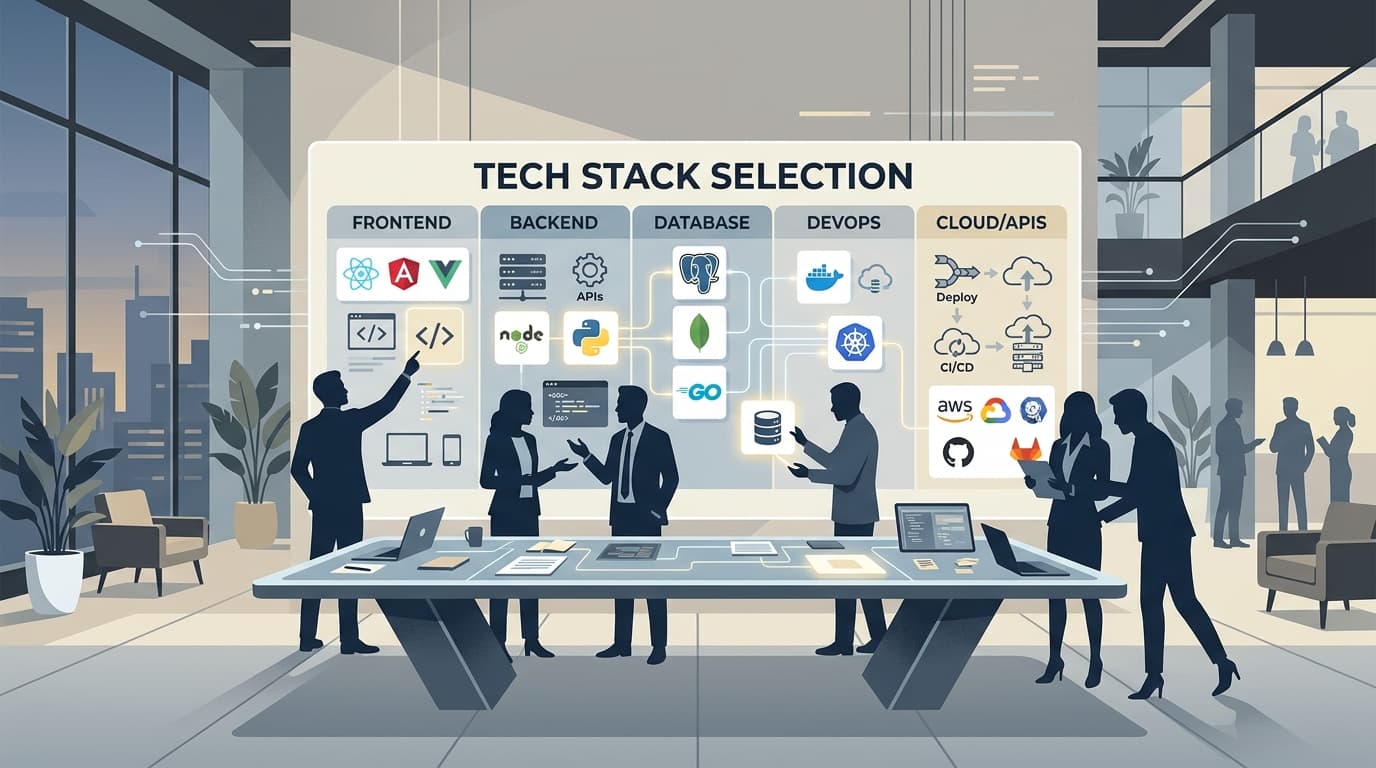
Most software projects don't fail because of bad code. They fail because of the wrong partner. Choosing a software development partner is one of the highest-stakes decisions you'll make this year. Get it right, and you gain a technology ally who accelerates your roadmap for years. Get it wrong, and you're looking at blown budgets, a codebase nobody wants to touch, and a go-to-market delay your competitors will happily exploit. The numbers are sobering. Nearly 70% of digital transformations fail to meet their original timeline, budget, or scope , and in most cases the root cause isn't technical. It's the wrong partner: a team that overpromised in the sales call and underdelivered in execution. Meanwhile, the market is flooded. The global software development outsourcing market is valued at $618 billion in 2026 and is on track to reach $977 billion by 2031. More options than ever, but also more vendors who look identical on paper. This guide gives you a clear, practical framework to cut through the noise. Step 1: Define what you actually need before you talk to anyone This is where most companies go wrong. They reach out to vendors before they've answered the most basic questions about their own project. That leads to a shortlist of agencies that all look similar on paper but fail to deliver in practice. Before you evaluate a single software development company, nail down: What problem are you solving? A vague brief produces vague proposals. Are you building from scratch or scaling an existing system? What does success look like in 6 and 12 months? Specific, measurable outcomes, not "a working product." What's your realistic budget range, including post-launch maintenance? How much internal technical oversight can you provide? Your answers here directly determine which type of partner you should look for. A team best suited for an early-stage MVP is rarely the right fit for a regulated enterprise migration. Clarity on your side makes evaluation infinitely easier on both sides. Step 2: Evaluate on these six dimensions, not price When evaluating a software development partner in 2026, a strong framework covers six areas: technical capability, delivery model, security and compliance, communication infrastructure, team stability, and reference quality. Price is the last filter, not the first. Technical capability Your partner should be genuinely fluent in the technologies your project requires, not just superficially familiar. If you need a React and Node.js application with AWS infrastructure, the team should have shipped production systems on that exact stack. Ask them to walk you through architecture trade-offs. A partner who just agrees with whatever you suggest is an order-taker, not a collaborator. AI capability is now a baseline expectation too. 83% of outsourcing executives are already integrating AI into their outsourced services , and developers using AI coding assistants complete tasks 55% faster on average. A partner without clear AI tooling in their delivery workflow is already slower and more expensive than one that does. Delivery model and process maturity Ask to see their deployment pipeline. If they can't demonstrate an automated Build → Test → Deploy sequence, they're likely relying on manual processes prone to error. True Agile delivery matters here: agile projects have a significantly higher success rate (64%) compared to waterfall projects (49%). Watch out for "Water-Scrum-Fall," the practice of dressing waterfall processes in agile vocabulary. Also clarify who you'll actually work with day-to-day. The most common unpleasant surprise in software development partnerships is the team presented in the sales process not being the team that works on your project. Insist on meeting your actual engineers before you sign. Security and compliance posture For regulated industries, the minimum bar in 2026 is ISO 27001:2022 certification, and you should confirm it covers software delivery, not just corporate operations. Ask for the last penetration test summary and remediation record. Supply chain attacks are a growing reality: 45% of global organizations are projected to be affected by a third-party breach by the end of 2026. Data security is not a nice-to-have conversation for later. Communication and timezone fit Communication problems hit 42% of outsourcing clients. That figure alone should make it a top evaluation criterion, not an afterthought. Ask how they handle ambiguity, how they escalate bad news, and what their async documentation standards look like. Timezone overlap matters practically: under two hours of live overlap per day pushes architecture decisions into async territory, which creates real risk. Nearshore options often provide a better balance of cost and communication. That said, offshore can absolutely work when communication structures are deliberately designed, not assumed. Team stability High turnover at a partner agency means knowledge leaks from your project every few months. Ask about their employment model: partners staffed primarily by contractors carry higher turnover risk. Team continuity should be a contract term, not a verbal assurance. References, and the questions most buyers don't ask Go beyond the polished case studies. Ask to speak to a client where things went wrong, and listen for how the partner handled it. "All our clients are 100% happy" is statistically impossible and a red flag. A partner who can walk you through an honest post-mortem is one who treats problems as solvable, not one who hides them until they're catastrophic. Step 3: Watch for these red flags during evaluation Not every warning sign is obvious. Some are subtle in early conversations but become expensive problems later. Vague pricing : unwillingness to discuss cost structure before an NDA, hidden fees for "standard" activities like QA or project management, or a model that incentivises the vendor to extend timelines rather than deliver results. Scope creep enablers : no clear process for handling change requests. Scope creep drives 20–30% budget overruns on average in outsourced projects. Code ownership ambiguity : you should own the repository and credentials from day one. A strong partner will confirm this upfront. A weak one will get evasive. Definition of success that starts and ends with scope fidelity : delivering what was in the document is a floor, not a ceiling. The best partners define success in terms of your business metrics, user adoption, time-to-market, operational efficiency. No AI in their workflow : in 2026, this isn't a differentiator, it's table stakes. A partner who can't articulate where and how they use AI tooling is already behind. Step 4: Understand the true cost of outsourcing before you commit Price comparisons across regions are tempting but misleading without context. Hourly rates for software developers range from $25–$50/hr in Asia and $40–$80/hr in Eastern Europe, up to $80–$150/hr in North America. Outsourcing custom software development can reduce time-to-market by 30–50%, which translates into real competitive advantage. But the cheapest hourly rate often leads to the highest total cost of ownership. Factor in: Management overhead on your side Quality rework (outsourced code carries an average 27% rework rate when vetting is skipped) Post-launch support and maintenance, often the most underestimated line item The cost of switching partners mid-project if things go sideways Outcome-based pricing is gaining ground fast. The shift from project-based to outcome-based engagements is the defining commercial trend in enterprise software development in 2026. Partners who price against delivered value, not hours logged, have better incentive alignment with your goals. Look for this model; it's a signal of maturity. Step 5: Start small before you go all-in The single most underused tactic in partner selection is a paid trial engagement. A discovery phase, a proof of concept, or a short sprint costs a fraction of a full build and tells you more about a team than any proposal or reference call can. What to look for in a trial engagement: Do they ask the right questions, or do they just take the brief at face value? How do they communicate when something is unclear? Is the delivered work clean, documented, and maintainable? Do they push back when a requirement is risky or unclear? (If they don't, they will just build what you ask, even when it's wrong.) A real partner surfaces problems early. That's not a weakness; that's exactly the behaviour you want when the stakes are higher. What the numbers say about software development outsourcing in 2026 The data paints a clear picture of where the market is heading, and what it expects from both buyers and partners. The global software development outsourcing market stands at $618 billion in 2026 , growing at a 9.6% CAGR toward nearly $977 billion by 2031. Only 34% of companies now cite cost as their primary outsourcing driver , down from 70% in 2020; access to specialist skills has become the real motivation. Quality has overtaken price: 84% of executives now rank service quality as their top selection factor when choosing a development partner. Cultural misalignment remains the silent killer: 60% of outsourced projects that fail cite poor cultural compatibility as a root cause . And AI has moved from differentiator to baseline: 83% of outsourcing executives are already embedding AI into their delivery workflows. Software development outsourcing: key figures 2026 Executives ranking quality as top factor 84% Outsourcing executives using AI in delivery 83% Failed projects citing cultural misalignment 60% Outsourcing clients facing communication issues 42% Companies citing cost as primary driver (2026) 34% © ideomatics.com "Choosing a software development partner is ultimately about trust. Trust that they'll tell you the truth about timelines. Trust that they'll build something maintainable, not just functional. Trust that they'll be around when you need them six months after launch." Want to explore how this applies to your specific build? Read our breakdown of custom software development services to understand exactly what a real engagement looks like from discovery to delivery. Frequently asked questions about choosing a software development partner What's the difference between a software development partner and a regular outsourcing vendor? A vendor completes tasks to specification. A software development partner shares accountability for outcomes, contributes to architecture decisions, flags problems proactively, and treats your product roadmap as something they co-own with you. The distinction is meaningful: partners invest in understanding your business; vendors invoice by the ticket. How long should a software development engagement last before I evaluate fit? A paid discovery phase or trial sprint of two to four weeks is enough to assess communication quality, code standards, and how the team handles ambiguity. Don't commit to a multi-month build before that. The cost of a short trial is negligible compared to the cost of switching partners mid-project. What should I look for in a software development partner's portfolio? Look for case studies with verifiable, specific outcomes, not just technology logos and "delivered on time" claims. Can they show user adoption rates, performance improvements, or measurable business results? Better still, can you speak directly to a past client, including one where a project hit difficulty? That conversation tells you far more than any polished PDF. Is offshore software development still worth considering in 2026? Yes, but the calculus has changed. Cost is no longer the headline reason: only 34% of companies cite it as the primary driver, down from 70% in 2020. Access to specialist skills, AI capability, and delivery speed are now the main motivators. Offshore works when communication structures are deliberately designed and team stability is contractually protected. It fails when it's chosen purely for the hourly rate. What are the biggest red flags when evaluating a software development partner? Watch for: a sales team that doesn't introduce you to your actual delivery engineers, pricing models that reward extended timelines over shipped features, vague answers on code ownership, no documented process for handling change requests, and an absence of AI tooling in their workflow. Any one of these is worth probing hard. Several together is a clear reason to walk away.